VICTORIA, MINNESOTA
A cul-de-sac in Victoria gets one pass. That is the correct call and the city says so plainly: cul-de-sacs are plowed with a single pass to open up all routes as soon as possible. Widening and cleanup may carry on later the same day or resume the next one, depending on what the storm did.
The arithmetic behind that is worth seeing. Public Works maintains roughly 92 lane miles of streets and roads plus about 38 miles of trails, and a typical 3 to 6 inch event takes a crew of 10 somewhere between 70 and 90 hours on the first day, with another 40 to 60 hours on the second for hauling, cleanup and finishing the walking paths. Bigger events push those numbers higher. For a household at the end of a court, that can mean a full day of half-width street.
Which is exactly when the driveway has to do more work than usual: hold the cars, give somebody room to turn around, and meet whatever width of street has been opened so far. Service runs on a 2 inch trigger and the drive is cleared within 10 hours after snowfall stops, timed off the weather rather than off the city's progress down your block.
We can hold that number because the Victoria route is capped. No crew is ever carrying more drives than one shift will finish, and when the route fills we stop selling it. Sign on before the first storm and there is nothing else to arrange all winter.
Homeowners around Lake Minnetonka have left us 80+ five-star Google reviews.
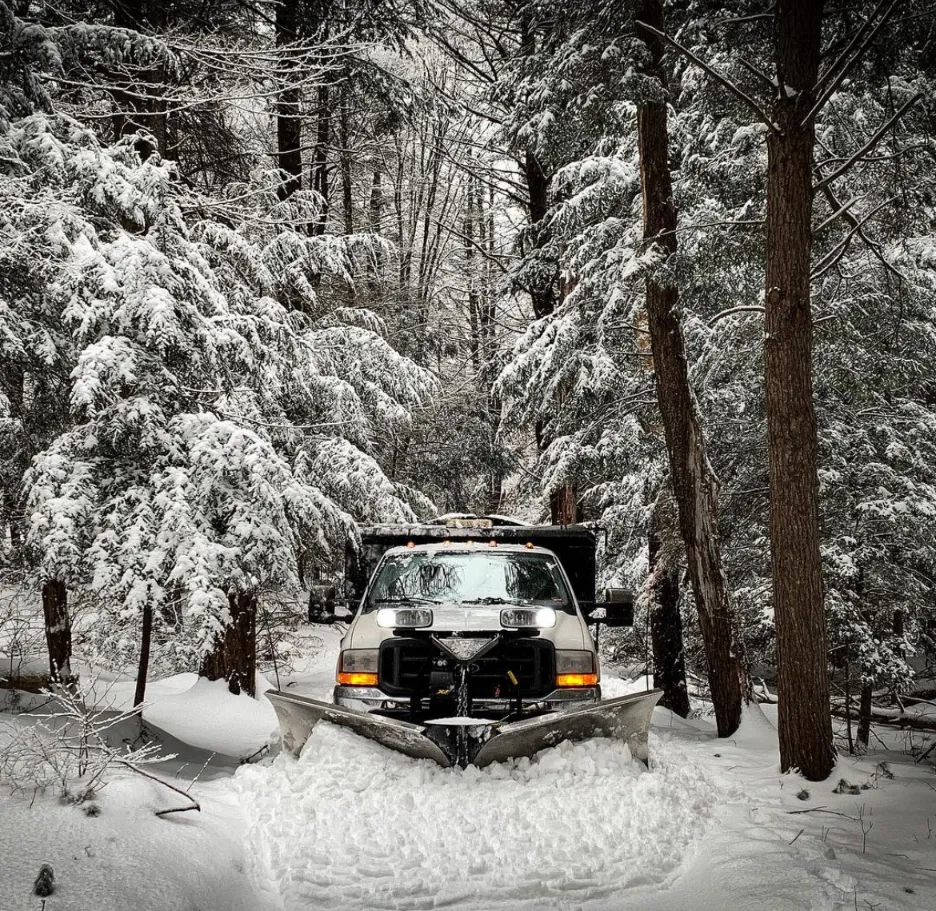
The city works to a clear plan. Plow operators hit the streets at approximately 3 a.m. after a snow event and keep going until every street is plowed, taking the center of the roadway first and then making passes in each direction. Routes are split into four areas with a large dump truck on each, while the remaining staff run two skid steers, two side-by-sides, five pickups or two tractors to support those routes and cover downtown, the trails, city-maintained sidewalks and the parking lots.
Cul-de-sacs get their single pass under that same plan, and widening may not come back around until later in the day or the day after. It is the right way to run 92 lane miles. It also means the part of the property you control has to carry more than usual for a while, with room to park, room to back out and turn, and an apron that meets whatever width the plow has opened.
Service triggers at 2 inches and the driveway is open within 10 hours after the snowfall stops. How that is measured matters as much as the number itself. Ten hours from the end of the weather is a commitment we control; ten hours from whenever a street gets finished would be a commitment about somebody else's day.
Residential trucks are set up with rubber cutting edges rather than steel. A steel blade grabs the joint between two pavers and the raised lip where a concrete apron meets the street, and it takes a little material every single time, which is how so much driveway damage ends up blamed on the weather. Before the ground hardens we stake the edges of the drive, because a crew pulling in at four in the morning on a lot with newer curbing and young plantings should be reading markers, not guessing.
What we bring to it is a winter operation of 15 to 20 crew working three plow trucks and two sidewalk machines, with two wheel loaders and two compact track loaders behind them for volume, and a backup crew named ahead of every storm so a machine down does not become your problem. Each visit is written into Yeti, our snow management platform, time-stamped and photographed.

Victoria puts the sidewalk in front of or on the side of a property on the owner, with 24 hours from the snowfall to get it cleared. Walks and steps are included in residential service and done on the same stop as the driveway, which takes that clock off anybody's list of things to remember on a Tuesday night.
The city also asks that snow not be shoveled or blown from driveways back into the street, a reasonable request and an easy one to break with a blower chute pointed the wrong way. Everything that comes off the drive and the walks stays on the property, stacked where it will not close a sight line or bury a mailbox.
Steps and stoops are cleared by hand, without exception. A machine crossing a tread takes a little off the nosing each time until the edge is rounded and chipped, so treads, landings and service doors get shovels instead. Larger driveways, longer walks and extensive step work are priced accordingly.
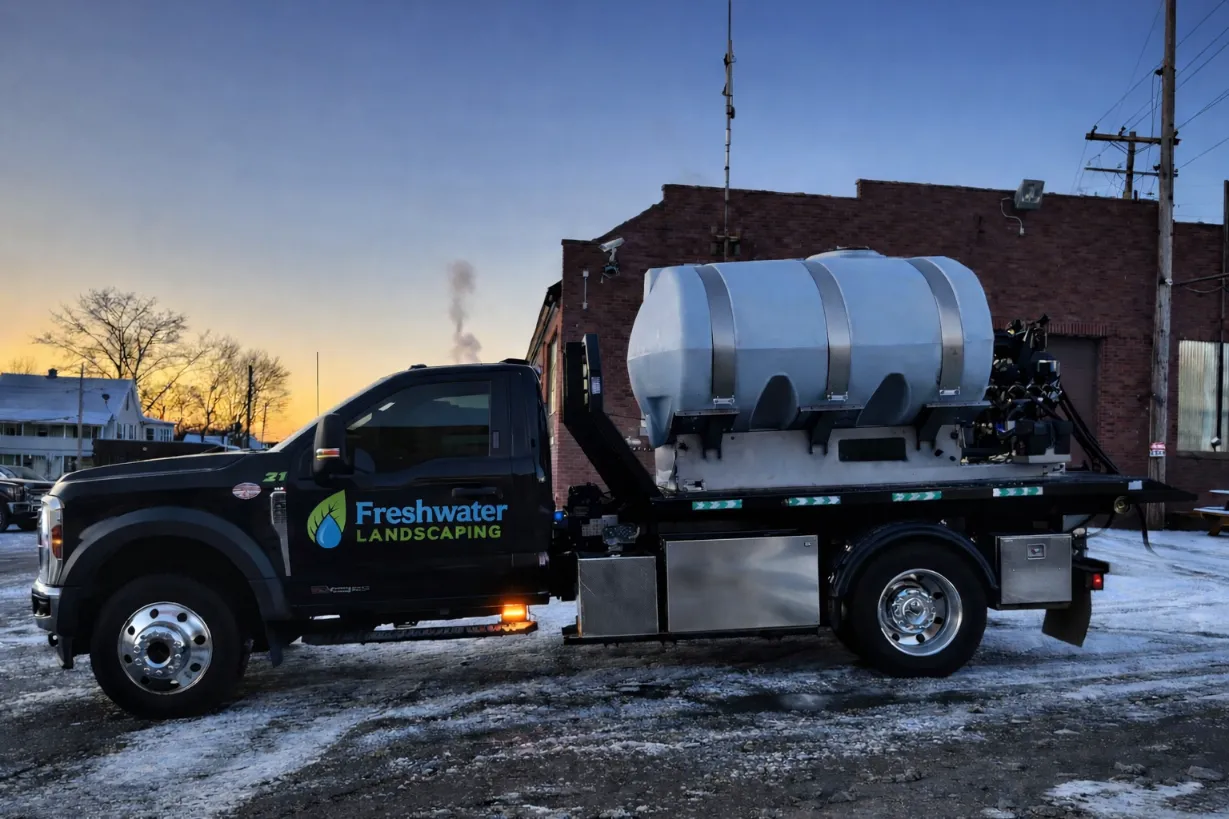
Most of the ice that matters forms on pavement somebody already cleared. A dark slab takes sun for a few hours, the water runs to the tire ruts and the low corner by the garage, and at dusk it sets into a sheet that is close to invisible from six feet away. Nobody expects to lose their footing on a driveway they watched get plowed that morning.
Treatment goes on the drive, the walks and the entry steps following MPCA Smart Salting best practices, which means working out where water actually collects and treating that, rather than covering an entire surface at one uniform rate. Less material placed where the refreeze happens does more than a heavier spread everywhere else.
Having it on hand is the other half of the requirement. There are 100 tons of salt at our shop before the first storm of the season, bought ahead of time, so a January run on supply never turns into a gap in somebody's service.

Snow taken off a driveway does not leave, it moves to the nearest edge, and the edges fill up. What that costs a property is parking. A drive that held three vehicles in November is holding two by the middle of February, and the missing space is sitting under a bank that has been building since the first storm of the year.
Parking is worth more than the bank is. City code keeps vehicles off the street any time two inches have accumulated, so a driveway that has quietly lost a third of its surface to old snow is a real problem rather than a cosmetic one. When the edges will not take any more, we move the piles to open ground elsewhere on the lot, or load them out and haul them away entirely.
Most Victoria driveways price out at $200 to $250 a month across the November through April season, set as a single seasonal figure and billed monthly.
Three features of a property decide where inside that range it lands.
The size of the slab. Two cars wide, about 20 feet, by up to 60 feet long is standard, near enough to 1,200 square feet. Every 1,000 square feet past that is worth roughly another pass, and it makes no difference whether the surplus comes from a wider apron, a longer run, a turnaround or a pad built for a trailer. Approaches over 150 feet are quoted on their own.
The share that cannot be done from a seat. Fifty linear feet of walk and four steps come with the base rate. Everything beyond that is measured in time rather than footage, since long sidewalk frontage, a walk that wraps the house or a full flight of steps is shovel work from one end to the other.
Room for a winter's worth of snow. Nothing extra where there is open ground at the end of the drive to take it. The price moves for pavement hemmed in by walls, beds or a garage at the dead end, and for a lot where the only spare ground would bury a mailbox or close off the view out of a court. Relocation and hauling are quoted separately.
Seasonal or per push. Seasonal is one figure divided into six monthly payments, and seasonal properties come first on the route. Per push is available as well, and a short call is usually enough to work out which one fits.
Every figure here assumes the standard 2 inch trigger. Tightening it raises the price further than adding pavement would, because the change lands in how many visits happen rather than how long each one takes, so those properties are priced individually.
Victoria Municipal Code Ch 24-III Sec 24-50 prohibits parking a vehicle, special vehicle or other object on public streets or alleys any time two inches or more of snow has accumulated, and it counts drifting and blowing snow off earlier storms exactly the same as a fresh snowfall. The restriction holds until public snow removal has been completed on that street or alley. Plow operators are out at approximately 3 a.m. after an event and work until every street is plowed, taking the center of the roadway first and then running passes in each direction, with cul-de-sacs getting a single pass so all routes open as soon as possible and widening carrying over to later in the day or the next one. We build the Victoria route around that sequence, which is why our standard is 10 hours after the snowfall stops and why we open the full width of a driveway rather than a lane through the middle of it. Snow and ice removal details from the City of Victoria.
Freshwater Landscaping
3425 Shoreline Dr Ste B, Wayzata, MN 55391
(612) 999-8067
Office: Mon-Sun 8am-6pm
Most Victoria driveways run $200 to $250 a month across the November through April season, set as a single seasonal figure and billed monthly instead of charged per storm. Larger driveways, longer walks and extensive step work are priced accordingly, and you have the number before the season opens rather than after the first event.
Accumulation of 2 inches puts your property on the route for that storm, so there is no call to place and no confirmation to wait on. The driveway is cleared within 10 hours after the snowfall stops, a standard measured from the end of the weather rather than from how far the city has gotten down your street.
No. Victoria Municipal Code Ch 24-III Sec 24-50 makes it unlawful to park a vehicle or leave an object on a public street or alley any time two inches or more of snow has accumulated, and snow that drifted or blew in from an earlier storm counts the same as snow that fell last night. It stays unlawful until the city has completed snow removal on that street or alley, and the ordinance reaches past cars to trucks, vans, buses, trailers and campers whether motorized or not, motorcycles, bicycles, snowmobiles, ATVs and golf carts, along with other objects left at the curb such as a boat on a trailer. Everything has to fit on the driveway, which is why we open the full width of the slab rather than a single lane through the middle of it.
They are part of residential service and get cleared on the same stop as the drive. That carries weight in Victoria, where residents are responsible for the sidewalk in front of or on the side of their property within 24 hours of a snowfall, and a single visit covering drive, walk and steps lands well inside that window. Larger driveways, longer walks and extensive step work are priced accordingly.
Residential trucks carry rubber cutting edges instead of steel, because a steel blade catches the joint between two pavers and the lip where a concrete apron meets the street and shaves off a little every time it crosses. We stake the edges of the drive before the ground hardens so a crew arriving at four in the morning can read the boundary under fresh snow, and anything tight or fragile is finished by hand or with a blower.
Each Victoria visit is recorded in Yeti, our snow management platform, with a time stamp on the service record and photos alongside it. If a question comes up later about when the drive was done or how the edges looked when the crew pulled away, the answer is a dated photograph instead of somebody's memory.
Yes. Commercial properties choose the depth that sends us out, and the options are 2 inch, 1 inch, half inch, or zero tolerance with crews staged on site clearing continuously as the snow comes down. Documentation is identical to residential service, so every trip to the site carries a time-stamped record and photos for whoever has to answer for the lot.

Winter is usually not the first thing we do for a Victoria property. It starts with a patio, a grading problem along the back of the house, or a tree that should have come down two summers ago, and the snow work follows because the crew is already familiar with the place.
The reverse happens as well. Whoever opens your drive in January can widen it in June, keep the lawn on a weekly route through the season and clean the yard up in October, and they arrive already knowing where the pavement stops and what is planted beside it.
That is also why the plowing is careful. A company that spends its summers building paver drives on compacted base has no interest in spending its winters scraping them with steel.
Routes fill and then we're closed. Tell us about your property and what needs clearing, and we'll get you a spot. The storm-alert checkbox is optional. Check it and you'll get a text the moment crews head out.