PLYMOUTH, MINNESOTA
Your driveway is cleared within 10 hours after the snow stops falling. Not "as soon as possible." Not "we'll get to you." Ten hours from the last flake.
In Plymouth, the public sidewalk running past your house is your responsibility, not the city's. Plymouth City Code Section 820 gives the property owner 48 hours after a snow event to clear it, and failing to do it can bring a fine. The city takes care only of the walks in its own maintenance program, those come through roughly 48 hours after a 2 inch snowfall, and they are not cleared down to bare pavement. If there is public walk along your lot, that clock starts the moment the snow stops.
The streets keep their own schedule. A 2 inch snowfall puts the city into a snow emergency: every street gets plowed curb to curb and on-street parking is off limits until that work is finished. Plymouth also keeps cars off the street from 2 a.m. to 5 a.m. all year. Which means the morning after a storm can hand you three things at once — a plowed street, a fresh ridge across the end of your driveway, and a 48 hour sidewalk deadline already running.
Most Plymouth homeowners sign up for the season and stop thinking about it. Your property goes on the route before the first storm, service runs on a 2 inch trigger, and crews come when accumulation hits it — no phone call at 5am to ask whether we're coming. Seasonal flat rate or per push, whichever suits a winter that might bring four events or fourteen. Driveway, the walk to your front door and the steps are all part of it. Routes fill and then we're closed.
Homeowners across Plymouth and the west suburbs have left us 80+ five-star Google reviews.
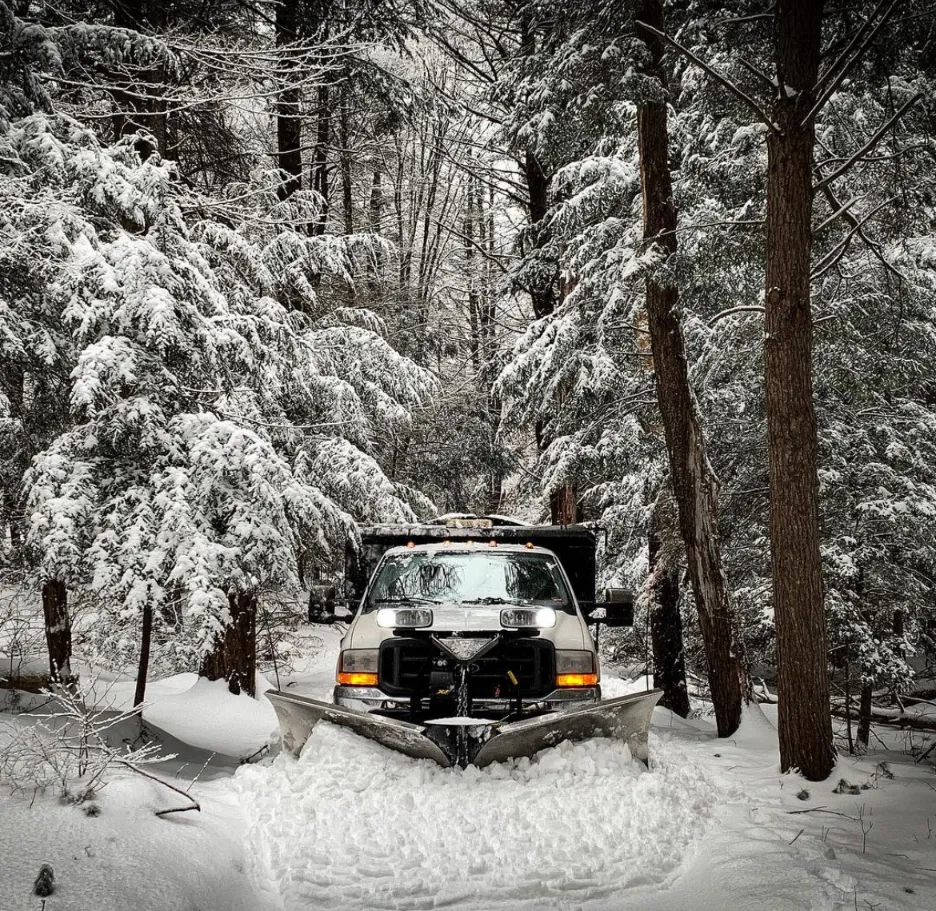
The residential fleet runs rubber cutting edges, not steel. That is a deliberate expense and it exists because of what steel does to a finished driveway: it grabs the lip of a paver, skips across a stamped concrete seam, scours fresh sealcoat, and leaves behind damage that shows up in April looking like ordinary weathering. It is not weathering. Somebody dragged a steel blade across your driveway forty times.
A lot of these driveways are ours to begin with, installed in July by the same company showing up in January, which is a strong incentive to be careful with them. Edges get staked before the ground locks up so that a crew running a wide drive in Plymouth Preserve at 3am can see exactly where the concrete ends and the turf starts. Anywhere a truck is the wrong tool — brick aprons, tight courts, narrow side pads — gets a hand crew or a blower. Every storm has a backup crew assigned before it arrives, and we hold spare machines in each equipment class.
Service triggers at 2 inches of accumulation. Hit that and your property is already on the list for that storm; there is nothing for you to phone in.

This is the part of winter that carries an actual deadline in Plymouth. Under City Code Section 820, clearing the public sidewalk next to your property is the owner's job, and the window is 48 hours from the end of the snow event. Miss it and the city can issue a fine. Plymouth clears only the walks inside its own maintenance program, they arrive roughly 48 hours behind a 2 inch snowfall, and they are not cleared to bare pavement — so on any lot with public frontage, that stretch of concrete is yours to answer for.
Walks and steps are included in residential service, cleared on the same visit as the driveway rather than on a trip somebody has to schedule later. Where a property carries public sidewalk footage, that can go on the ticket too, which is generally the cheapest way to stay on the right side of a 48 hour clock in February.
Steps, stoops and service doors are hand work. A machine on a stair tread rounds the nosing off, so we don't put one there, and the same goes for the brick and flagstone entries around Hollydale and Parkers Lake where a repair costs far more than the few minutes saved.

Getting the snow off is the easy half. The trouble starts hours later, when a clean dark surface takes on afternoon sun, gives up a thin film of meltwater, and then hands it back as ice the moment the temperature drops after dark. That glaze is what puts people on the ground and cars into mailboxes, and it forms on a driveway that looks perfectly clear.
We treat the drive, the walks and the entry steps — everywhere feet and tires actually land between storms. Salt is stocked ahead rather than chased down mid-winter: 100 tons sit at the shop before the season starts, so the supply crunch that follows a big regional storm is a problem we absorb instead of one we pass along.

Snow does not disappear when it is plowed, it just moves to the edge of the driveway and waits. Storm three or four is usually when a homeowner notices the cost of that: banks tall enough to blind you backing out, a turnaround that no longer turns around, and a drive that has quietly lost a couple of feet off each side. Newer subdivision lots feel it first, since the setbacks leave less ground to push toward than an older property has.
Once the edges are full, stacking higher stops working and starts causing problems. At that point we move the pile instead — relocated to open ground somewhere else on the lot if there is any, and loaded out and hauled away if there is not.
Most standard Plymouth driveways run $200 to $250 per month, November through April. One seasonal price, billed monthly.
What moves the number: the length and width of the drive, how much walk and step work comes with it, and whether the property needs snow relocated once the banks fill.
Driveway length and width. Standard is up to two cars wide, about 20 feet, and up to 60 feet long — roughly 1,200 square feet. Wider than three cars, longer than 60 feet, or a courtyard or turnaround at the top moves it up. Every additional 1,000 square feet is roughly another pass. Approach drives over 150 feet get quoted on their own.
Walk footage and number of steps. Standard covers up to 50 linear feet of walk and up to four steps. A second entry such as a side or service door, a walk that wraps the house, or a full stair run is hand work and costs more per foot than open walk.
Whether snow can be stacked on site. No added cost when there is open ground at the end of the drive with room for a season's volume. It moves up when retaining walls, beds or plantings sit tight to the pavement, or when the drive dead ends at the garage with nowhere to push. Relocation or hauling is quoted separately and usually only comes up on tight sites in a heavy winter.
Seasonal or per push. Seasonal is one price split into monthly payments November through April, and seasonal clients are cleared first. Per push is available — call us and we will talk through whether it fits your property.
All of the above assumes a 2 inch trigger. A tighter trigger moves the number more than driveway size does, so a property that wants closer to bare pavement all winter gets priced on its own.
A 2 inch snowfall triggers a snow emergency in Plymouth: all city streets are plowed curb to curb, and on-street parking is prohibited until that work is done. The city also bans on-street parking from 2 a.m. to 5 a.m. year round. Sidewalks are a separate obligation — under City Code Section 820 the property owner has 48 hours after the snow event to clear the public walk adjacent to the property, and a fine is possible for missing it, while the walks the city does maintain take about 48 hours after a 2 inch snowfall and are not cleared to bare pavement. Sidewalk and plowing details from the City of Plymouth.
Freshwater Landscaping
3425 Shoreline Dr Ste B, Wayzata, MN 55391
(612) 999-8067
Office: Mon-Sun 8am-6pm
When the snow quits, the drive is open within 10 hours. The reason that holds up is a route we deliberately keep small, so there is no unlucky property sitting at the back of a list that runs into a second day.
You are. Plymouth City Code Section 820 puts the public sidewalk next to your property on the property owner, with 48 hours after the snow event to get it cleared, and a fine is possible if it does not happen. The city clears only the walks in its own maintenance program, which run about 48 hours behind a 2 inch snowfall and are not taken down to bare pavement, so waiting on a city crew is not a plan for your own frontage.
You do not have to ask. Two inches puts Plymouth into a snow emergency and every street gets plowed curb to curb, which is exactly what packs a ridge across the bottom of your driveway. Clearing that ridge is written into the route rather than something you have to call in and request.
It should not, because the residential trucks run rubber cutting edges instead of steel. Steel is what grabs a paver lip or a stamped concrete seam and takes a corner off it. We also mark the drive edges before freeze-up so a crew working in the dark can read where the surface stops, and anything tight or delicate is finished by hand or with a blower.
Residential service takes in the walks and the steps along with the drive, all on one stop. Front steps, stoops and side entries are done by hand because machines round off edges, and properties with long walks, wide drives or a lot of stair work are quoted to reflect that time.
There is no need to be there. Accumulation is what dispatches the crew, not a call from you, so service happens whether the driveway is watched or empty. Pulling vehicles off the drive ahead of a storm is the one thing that genuinely helps, since we would rather clear the whole slab than trace a path around a parked car.
That depends entirely on whether the Plymouth route still has an opening. Holding a 10-hour standard means capping how many properties go on it, and once the cap is reached the route closes for the winter. Send the address over and we will tell you straight away whether there is space.

Most of our snow clients did not start as snow clients. They hired us for a patio, a drainage fix, or weekly mowing, and kept us through the winter because the crew already knew the property.
It works the other way too. The crew that plows your drive in January is the same one that can edge the beds in May, keep the lawn on a weekly route through the summer, and take down the tree that has been leaning over the garage since the last storm. One company, one number, one crew that already knows where your sprinkler heads are and which side of the drive holds water.
That is also why the winter work is careful. We know what goes into setting a paver drive on a proper base, so we are not going to spend four months dragging steel across it.
Routes fill and then we're closed. Tell us about your property and what needs clearing, and we'll get you a spot. The storm-alert checkbox is optional — check it and you'll get a text the moment crews head out.