MINNETRISTA, MINNESOTA
Minnetrista has two winter parking rules, and the second one is what catches people. The first is the familiar one, no parking on city streets from November 1 through March 31 between 2:00 a.m. and 6:00 a.m. The second pays no attention to the clock: during continuous snowfall with an accumulation of 2 inches, vehicles stay off city streets until that street has been plowed to the full width of the roadway.
Full width, not opened. Those are two different milestones, and the distance between them is longer out here than it is on a tight city block, because Public Works is working a mix of paved streets and gravel roads with 90 miles of ditches running alongside them. A road can be perfectly drivable and still not be finished, and until it is finished the shoulder is not a parking spot.
What that leaves you with is a driveway that has to hold every vehicle on the property, occasionally for longer than one night. Usable capacity is the whole issue in this city, so we open the apron, the turnaround and the parking width rather than one lane up the middle, on a 2 inch trigger, within 10 hours after snowfall stops.
Holding that number takes a route with a limit on it, so crews never carry more drives than one shift can finish. The list closes when it is full. Getting on it in the fall is the entire commitment.
Homeowners around Lake Minnetonka have left us 80+ five-star Google reviews.
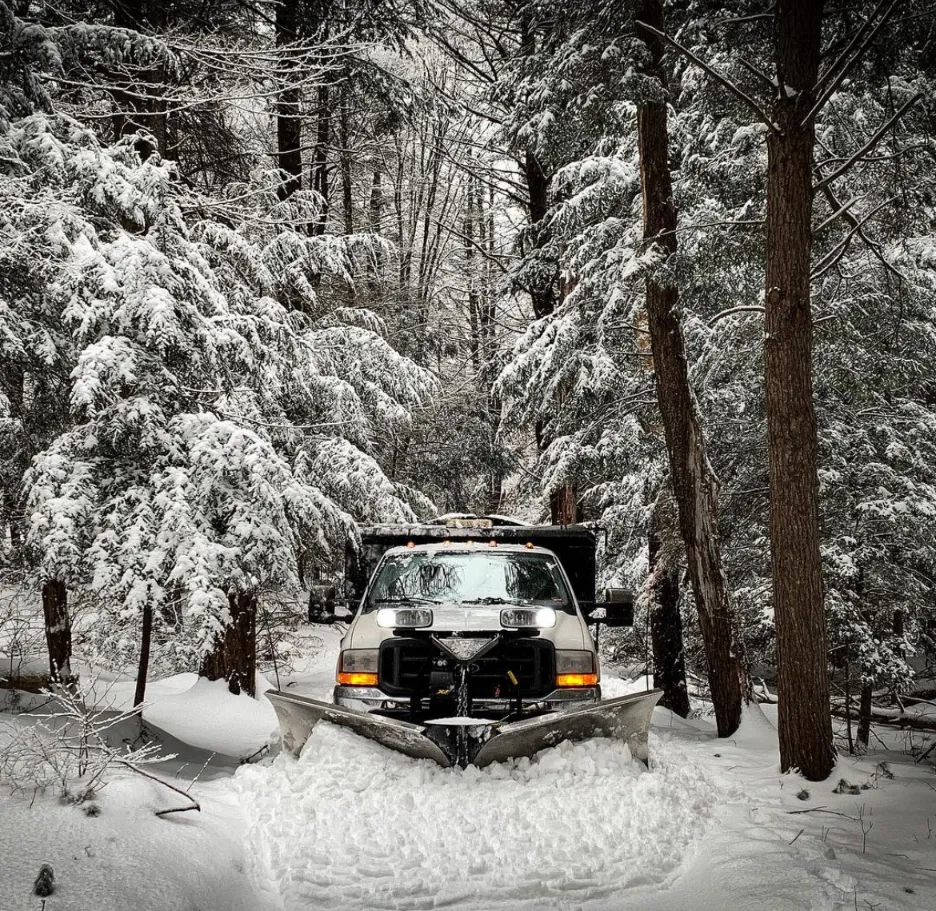
The rule that shapes a Minnetrista winter is the full-width one. The city asks residents to keep vehicles off city streets during continuous snowfall with an accumulation of 2 inches, and to leave them off until the street has been plowed to the full width of the roadway. That is a higher bar than an open lane, and reaching it takes longer on rural and gravel stretches than it does on a block of city pavement. Until then, the driveway is the only place anything with wheels can legally sit.
So we treat the driveway as parking rather than as a path through. The apron where it meets the road gets opened, the turnaround if there is one, and the extra width beside the garage where the second and third vehicles actually live. A single lane up the middle looks finished from the front window and leaves a household with exactly one usable space.
Out here the edge of the drive is frequently a guess. A lot of Minnetrista has no curb line at all, just a shoulder falling away toward one of the 90 miles of ditches the city keeps, and a blade that drifts a foot wide finds gravel and turf instead of pavement. None of that announces itself in January. It shows up in April, as thin grass along the drive with a fan of rock sitting in it. Drive edges get staked before the ground freezes so the boundary is readable at four in the morning under fresh snow.
Residential trucks carry rubber cutting edges instead of steel for related reasons. Steel catches the joint between pavers and the lip at a concrete apron and takes a little on every pass, and on aggregate or chip-sealed surfaces it pulls material loose outright. Rubber lifts the snow and leaves what is underneath where it was.
Behind the route are 15 to 20 crew running three plow trucks and two sidewalk machines, with two wheel loaders and two compact track loaders for the volume work, and a backup crew named before each storm rather than after something breaks. Service runs on a 2 inch trigger, the drive is open within 10 hours after the snowfall stops, and each visit is written into Yeti, our snow management platform, with a time-stamped record and photos.

A long rural drive makes the walk look like nothing, right up until somebody is carrying groceries across it in the dark. Walks and steps are included in residential service and cleared on the same stop as the drive, so the last thirty feet are not the part that gets left.
Mailbox posts deserve a look before the season, and the city asks residents to give them one: check the wood for rot or splits, check the metal for rust or weak spots, and make sure the screws, bolts and nails are still tight. The USPS wants the box 6 to 8 inches behind the gutter line and 41 to 45 inches above the surface of the road. A post already loose in October is a post that comes apart in January, and our crews give them room either way.
No machine touches a set of steps. Run one up a tread and the nosing gives up a little on each crossing until the edge is chipped and rounded off for good, so stairs, landings and service doors get shovels and nothing else. Larger driveways, longer walks and extensive step work are priced accordingly.
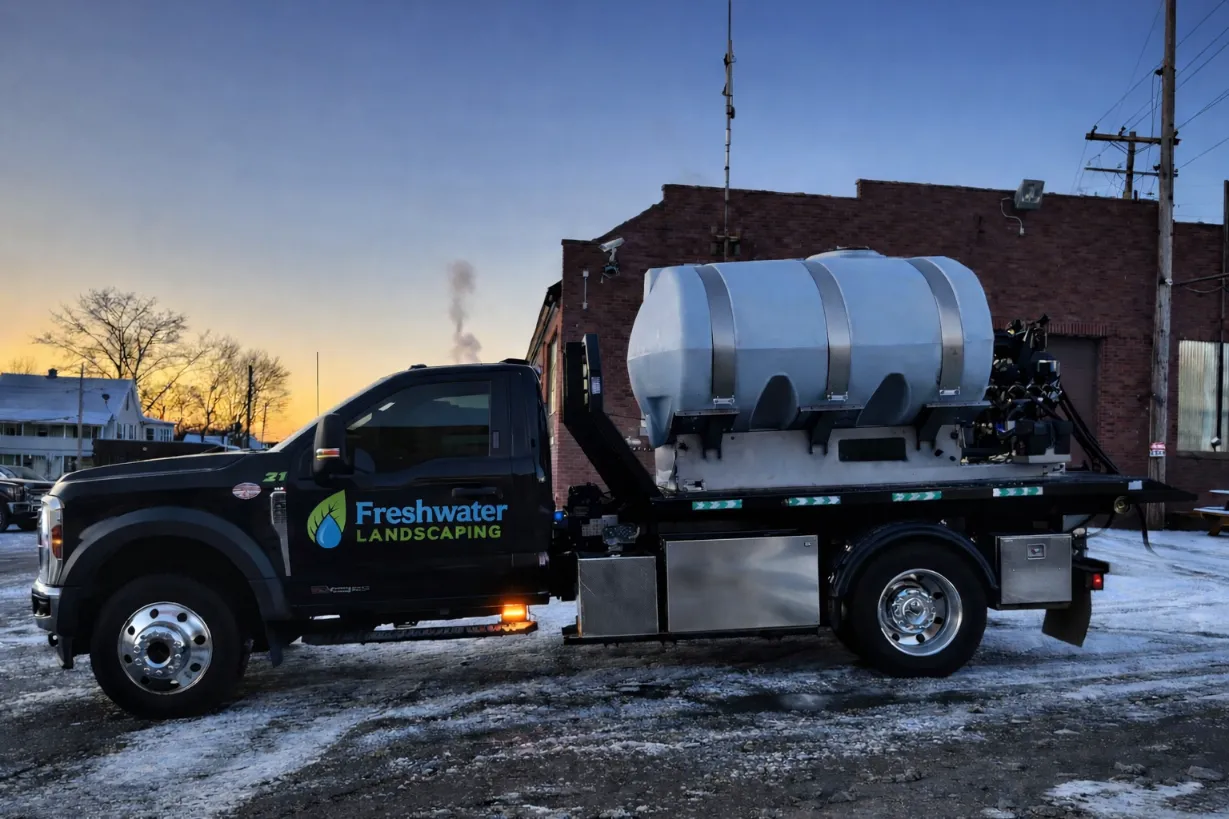
On a drive long enough to have a grade in it, ice stops being a walking problem and becomes a vehicle problem. A sheet across a pitch means something starts moving on its own, and plenty of approaches here run downhill to a road with a ditch beside it.
Treatment goes on drives, walks and entry steps following MPCA Smart Salting best practices, which means finding where meltwater actually gathers and working those places rather than laying down a uniform rate across every square foot. A long drive does not need a long drive's worth of material. It needs the correct amount in four or five spots.
Salt for all of it is purchased before November and stored at our shop, 100 tons of it, which keeps us out of the scramble that follows every storm big enough to drain supply across the region.

A long driveway has more edge than a short one, and all of that edge fills. On a deep approach the banks creep in from both sides through January until two vehicles can no longer pass each other halfway up, and by February the top of the drive is a slot rather than an opening.
Where there is open ground the answer is simply to move the pile instead of building it taller, and most properties here have somewhere it can go. Where a drive runs with a ditch on one side and plantings on the other, the snow has to leave the site completely, and we load it out. Either way the aim is to have the width back before the next storm arrives to test it.
Seasonal service on a typical drive here sits in the $200 to $250 per month band and runs November through April, paid in monthly installments against a single price set before the snow starts.
Rural properties spread wider across that range than city ones do, and three things explain why.
Length and width of the drive. The standard is two cars wide, about 20 feet, and up to 60 feet long, roughly 1,200 square feet. Each 1,000 square feet past that is worth about another pass, and around here the surplus usually comes from length rather than width. An approach over 150 feet is quoted on its own, which covers a fair number of drives in this city.
Walk footage and step count. Fifty linear feet of walk and four steps are in the base rate. Beyond that the price follows time rather than distance, since a path from a detached garage, a walk that wraps the house or a full flight of steps is hand work the whole way.
Where the snow can go. Open ground beside the drive keeps the number flat, and most rural lots have plenty. It climbs where a ditch runs tight along one side, where beds and walls close in on the pavement, or where the drive dead ends at the garage with nothing behind it. Relocation and hauling are quoted separately.
Seasonal or per push. Seasonal is one price split into six monthly payments, and seasonal properties are served first. Per push is available too, and a short conversation usually settles which suits a given drive.
Everything above assumes the standard 2 inch trigger. A tighter one costs more than extra length does, because it multiplies visits rather than the work inside a visit, so those properties are priced one at a time.
The City of Minnetrista runs two winter parking rules. The first prohibits parking on city streets from November 1 through March 31 between 2:00 a.m. and 6:00 a.m. The second is the one worth planning around: during continuous snowfall with an accumulation of 2 inches, residents are asked to refrain from parking on city streets until the street has been plowed to the full width of the roadway. Full width is a later milestone than an open lane, and Public Works reaches it across a mix of paved streets and gravel roads with 90 miles of ditches alongside them. We build the Minnetrista route around that, opening the apron, the turnaround and the parking width rather than a single lane, on a 2 inch trigger and within 10 hours after the snowfall stops. Winter reminders from the City of Minnetrista.
Freshwater Landscaping
3425 Shoreline Dr Ste B, Wayzata, MN 55391
(612) 999-8067
Office: Mon-Sun 8am-6pm
Expect a typical drive here to price between $200 and $250 each month. The season runs November through April, and the figure is set once and then paid in installments rather than recalculated after every storm. Larger driveways, longer walks and extensive step work are priced accordingly, and a long rural approach gets a number of its own instead of being forced into the standard rate.
The trigger is 2 inches, so your property goes on the route for a storm the moment accumulation reaches it and no call is needed from you. The drive is cleared within 10 hours after the snowfall stops, measured from the end of the weather rather than from whenever the city finishes your road.
Minnetrista runs two separate rules. The first bans parking on city streets from November 1 through March 31 between 2:00 a.m. and 6:00 a.m. The second applies during continuous snowfall with an accumulation of 2 inches, and it keeps vehicles off city streets until that street has been plowed to the full width of the roadway, which is a later milestone than simply being opened. That is why we clear the apron, the turnaround and the parking width instead of one lane, because the driveway has to hold everything until the road is finished.
Yes, and they are the reason we stake drive edges before the ground freezes. With no curb line to follow, a marked edge is what tells a crew at four in the morning where your surface stops and the shoulder begins, and rubber cutting edges keep a blade from lifting loose aggregate the way steel does. To be clear about scope, we clear driveways, walks and steps; the gravel roads themselves belong to the city.
Both are part of residential service and get finished during the visit that clears the drive. Hand crews take the stairs, the landings and the service doors, because a machine rounds a stair edge off a little more with every crossing. Larger driveways, longer walks and extensive step work are priced accordingly.
Every Minnetrista visit is logged in Yeti, our snow management platform, with a time-stamped service record and photos. On a property where the edge of the drive is soft ground rather than concrete curb, a dated picture of how those edges looked when the crew pulled out is worth having come spring.
Yes. Trigger depth is the choice a commercial site makes, and the range runs from the standard 2 inch through 1 inch and half inch down to zero tolerance, where crews stage on site and clear continuously for as long as the snow keeps falling. Whatever the tier, documentation matches residential exactly: a time-stamped record and photographs behind every trip to the property.

Most of these winter accounts started with a summer problem. A drive that needed rebuilding, water standing where nobody wanted it, a row of trees that had stopped being an asset. Snow service followed because the crew had already walked the property in daylight.
Daylight matters more than it sounds like it should. The people who regraded an approach in July are the ones reading it under snow in January, and they already know which side the ground drops away toward the ditch on.
It explains the equipment choice as well. A company that spends its summers building driveways has no interest in spending its winters taking them apart with a steel blade.
Routes fill and then we're closed. Tell us about your property and what needs clearing, and we'll get you a spot. The storm-alert checkbox is optional. Check it and you'll get a text the moment crews head out.