MINNETONKA, MINNESOTA
Your driveway is cleared within 10 hours after the snow stops falling. Not "as soon as possible." Not "we'll get to you." Ten hours from the last flake.
Start with something Minnetonka is refreshingly blunt about. Bare pavement is not the goal of the city's snow removal. Streets get cleared and then treated so that whatever stays behind melts off on its own, which is a reasonable way to handle a city's worth of lane miles and also means the surface outside your house is not the surface you are picturing. The city is just as direct about the other end of it: plowing will leave snow at the end of your driveway, that is unavoidable, and clearing it is the property owner's responsibility. So the berm is yours. It was always going to be yours.
Minnetonka does hand you one genuinely useful thing, though, and most people never pick it up: free curb markers, available at city hall and public works, meant to go in before the ground freezes so a plow driver can see where your lawn and driveway actually end. That is precisely what our crews do on the properties we take, staking drive edges ahead of the freeze so a truck working in the dark is reading markers instead of guessing at a boundary buried under a foot of snow. It matters more here than people assume, because damage to private improvements sitting in the right-of-way — sprinkler heads, rock gardens, the low wall somebody put in years ago — is the owner's problem and not the city's.
Most Minnetonka homeowners sign up for the season and stop thinking about it. Your property goes on the route before the first storm, service runs on a 2 inch trigger, and crews come when accumulation hits it — no phone call at 5am to ask whether we're coming. Seasonal flat rate or per push, whichever suits a winter that might bring four events or fourteen. Driveway, the walk to your front door and the steps are all part of it. Routes fill and then we're closed.
Homeowners across Minnetonka and the west suburbs have left us 80+ five-star Google reviews.
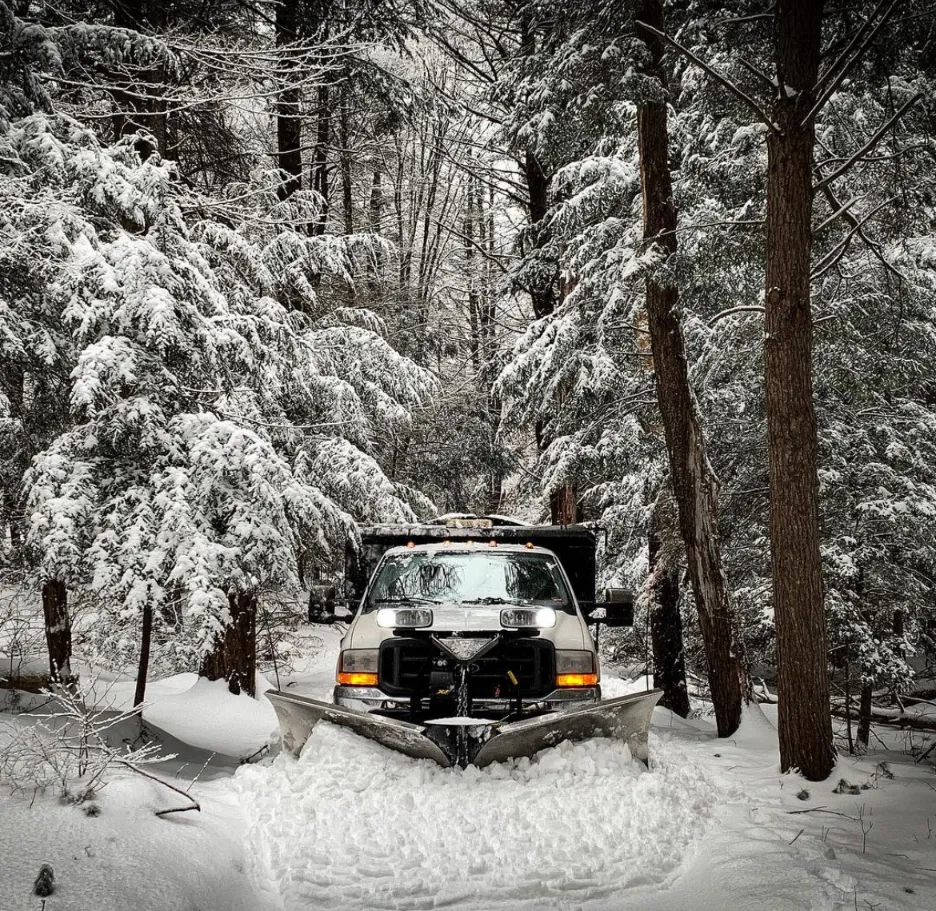
The city has told you how this ends. Minnetonka states that bare pavement is not the goal of its snow removal, and that plowing will leave snow at the end of your driveway, that this cannot be avoided, and that clearing it is the property owner's job. There is no ambiguity to appeal to and nobody to call about it. Citywide plowing starts once two inches are down, usually somewhere between 2 and 4 in the morning, which is also roughly when the berm across your apron gets built.
Against that we run rubber cutting edges on every residential truck. Steel is what quietly wrecks a finished driveway: it hooks a paver lip, jumps a stamped concrete seam, lifts sealcoat in strips, and the damage shows up months later looking like ordinary Minnesota weathering rather than something a blade did. Rubber crosses the same surface and leaves it intact.
The staking matters just as much. Minnetonka gives out free curb markers and asks that they go in before the ground freezes so plows can see where lawn ends and pavement begins — we do the identical thing on the drives we service, setting edge stakes ahead of the freeze. The stakes earn their keep here, because anything private sitting in the right-of-way is the owner's risk, not the city's, and on these lots that usually means sprinkler heads, low walls and rock beds sitting inches from where a blade travels. Under two inches of fresh snow, a marker is the difference between a clean pass and a repair bill.

An open driveway and an unreachable front door is a job half finished. Walks and steps are part of residential service here, cleared during the same stop as the drive rather than turned into a second appointment somebody has to chase down. Front walk, the run around to a side entry, the treads and landing at the door: same crew, same visit, same ticket.
The lots make the case for including them. A lot in Sherwood Forest or Oak Knoll tends to set the house back behind trees with a walk that bends and climbs to get there, and Minnetonka Mills adds the older housing stock with entries built before anybody worried about how a machine would fit. Those are long minutes of hand work that a driveway-only plow route simply drives past.
Steps never see a machine. Running one up a stair tread shaves the nosing a fraction at a time until the edge is gone for good, so stairs, stoops and service doors get shovels, and the same rule protects the stone and brick entries that are common on these properties, where one cracked piece costs more than the time saved.

This is where the city's own approach explains why your driveway needs its own. Minnetonka does not clear streets to bare pavement — it clears them and then treats what is left so the remainder melts off over the following hours. That is a deliberate, sensible strategy across an entire street network. It is also the reason you can pull off a treated street onto an untreated driveway and find the worst footing of the day on your own property.
A drive that was cleared in the morning takes sun all afternoon, releases a film of meltwater across dark pavement, and locks it into glaze the moment the temperature drops after dark. So we treat the surfaces that carry feet and tires — drive, walks, entry steps — timed to when the refreeze actually arrives. The salt to do it is bought before the season rather than during it: 100 tons sit at the shop from the start, so a regional supply squeeze after a big storm changes nothing about what the route does the next morning.

Plowing is a relocation business with a fixed amount of somewhere to put things. What fills up first on a Minnetonka lot is rarely the yard — it is the narrow shoulder of usable ground between a wooded edge and the pavement, which is all a long drive through trees really offers. Push into the trees and you are packing snow against trunks and low branches you would rather keep.
By the third or fourth storm the pile has started running the property: the turnaround shrinks, the view backing toward the street disappears behind a wall, and each new push has less room than the one before. At that point the answer is to remove volume rather than stack it. Piles move to open ground where a lot has some, and get loaded and hauled off entirely where it does not.
Most standard Minnetonka driveways run $200 to $250 per month, November through April. One seasonal price, billed monthly.
What moves the number: the length and width of the drive, how much walk and step work comes with it, and whether the property needs snow relocated once the banks fill.
Driveway length and width. Standard is up to two cars wide, about 20 feet, and up to 60 feet long — roughly 1,200 square feet. Wider than three cars, longer than 60 feet, or a courtyard or turnaround at the top moves it up. Every additional 1,000 square feet is roughly another pass. Approach drives over 150 feet get quoted on their own.
Walk footage and number of steps. Standard covers up to 50 linear feet of walk and up to four steps. A second entry such as a side or service door, a walk that wraps the house, or a full stair run is hand work and costs more per foot than open walk.
Whether snow can be stacked on site. No added cost when there is open ground at the end of the drive with room for a season's volume. It moves up when retaining walls, beds or plantings sit tight to the pavement, or when the drive dead ends at the garage with nowhere to push. Relocation or hauling is quoted separately and usually only comes up on tight sites in a heavy winter.
Seasonal or per push. Seasonal is one price split into monthly payments November through April, and seasonal clients are cleared first. Per push is available — call us and we will talk through whether it fits your property.
All of the above assumes a 2 inch trigger. A tighter trigger moves the number more than driveway size does, so a property that wants closer to bare pavement all winter gets priced on its own.
Citywide plowing begins at two inches of accumulation and typically starts between 2 and 4 a.m. The city states that bare pavement is not the goal of its snow removal: streets are cleared and then treated to promote melting of what remains. It also states that plowing will leave snow at the end of your driveway, that this is unavoidable, and that clearing the driveway is the property owner's responsibility. Overnight parking on city streets is prohibited from 2 a.m. to 6 a.m., and no vehicle may remain parked in one place for more than six hours. Free curb markers are available at city hall and public works, and residents are asked to install them before the ground freezes so plows can see the edge of the lawn and driveway. Damage to private improvements in the right-of-way, such as sprinklers and rock gardens, is the property owner's responsibility rather than the city's. Snowplowing details from the City of Minnetonka.
Freshwater Landscaping
3425 Shoreline Dr Ste B, Wayzata, MN 55391
(612) 999-8067
Office: Mon-Sun 8am-6pm
Within ten hours of the last flake, and that is a number we hold rather than hope for. The route is capped on purpose, so the crew is never carrying more properties than one shift can finish, which is the only reason a time promise in this business means anything.
No, and the city says so directly: bare pavement is not the goal of its snow removal. Streets are cleared and then treated so that whatever is left behind melts off over the following hours, which is a sensible way to run hundreds of lane miles but does leave a bonded layer underfoot in the meantime. Your driveway gets the opposite treatment from us, cleared to the surface and then treated against the refreeze.
You do, according to the city, which states plainly that plowing will leave snow at the end of your driveway, that this is unavoidable, and that clearing it is the property owner's responsibility. We treat that berm as part of the job rather than an add-on, so it comes off during the same visit as the rest of the drive. Nobody has to call and report it.
Both, ideally. Minnetonka hands out free curb markers at city hall and public works and asks residents to install them before the ground freezes, so street plows can see where the lawn and driveway begin. We stake drive edges on the same schedule and for the same reason, which matters because damage to private improvements in the right-of-way, sprinklers and rock gardens included, falls on the property owner rather than the city.
Steel would. Ours are rubber, which is why they do not. A steel edge catches the lip of a paver, skips across a stamped concrete seam and scrapes sealcoat off in lines, and the bill for that arrives in spring looking like ordinary weathering. Rubber edges, staked boundaries and hand work in the tight spots are how we avoid handing you one.
Walks and steps come with it, cleared during the same stop rather than scheduled as a second visit. Stairs, landings and back entries are done by hand, because a machine takes the edge off a tread a little at a time. A property with a long walk or an unusual number of steps is priced for the work it actually takes.
Maybe, and the honest answer depends on how much of the Minnetonka route is already spoken for. We stop adding properties once it is full, because stretching a capped route is exactly how a ten hour standard quietly turns into an afternoon one. Send the address over and we will tell you yes or no without the runaround.

Most of our snow clients did not start as snow clients. They hired us for a patio, a drainage fix, or weekly mowing, and kept us through the winter because the crew already knew the property.
It works the other way too. The crew that plows your drive in January is the same one that can edge the beds in May, keep the lawn on a weekly route through the summer, and take down the tree that has been leaning over the garage since the last storm. One company, one number, one crew that already knows where your sprinkler heads are and which side of the drive holds water.
That is also why the winter work is careful. We know what goes into setting a paver drive on a proper base, so we are not going to spend four months dragging steel across it.
Routes fill and then we're closed. Tell us about your property and what needs clearing, and we'll get you a spot. The storm-alert checkbox is optional — check it and you'll get a text the moment crews head out.