HOPKINS, MINNESOTA
Hopkins gives property owners 12 hours to clear snow and ice from the public sidewalk, and the clock doesn't wait for the storm to end. City Code Section 36-175 counts from when the snow is deposited, not from when snowfall stops.
The same section covers the driveway apron, the stretch between the street and your property line where the city plow leaves its ridge. And the rule is the same for a storefront on Main Street as it is for a house.
So on Hopkins accounts, sidewalks don't wait for the lot trigger. The lot follows the depth you choose, and the sidewalks get shoveled and salted after every snowfall. Crews run out of our Wayzata shop, and Yeti logs each visit with photos and time stamps.
Clients across the Lake Minnetonka area have left us 80+ five-star Google reviews.
1.5 million square feet of commercial lots on contract and counting, for clients including Thunderbird Aviation at Flying Cloud Airport, Holiday Inn Express and Comfort Inn.

A commercial lot in Hopkins has to be ready before the business is. Customers, tenants and employees all arrive expecting open lanes, clear stalls and entrances they can see out of.
Crews plow at the trigger depth set in your contract, and on storms that hit during business hours they come back to keep the lot open while it's in use. Piles go where they cost the fewest stalls and don't block the view at your exits.
A crew of 15 to 20, sized to the storm, runs the route, backed by spare equipment in every class: two wheel loaders, two compact track loaders, three plow trucks and two sidewalk machines. One machine going down doesn't take a route with it.
Hopkins also requires vehicles to come off its streets, city parking lots and the Municipal Parking Ramp during a snowfall, so crews can clear them. If your tenants or customers usually park on the street, that changes how much of your own lot needs to be open, and when.

City Code Section 36-175 puts three surfaces on the owner or occupant of the property next to them: the public sidewalk, the carriage walk and the driveway apron. All three have to be kept clean and safe for pedestrians at all times, and snow or ice can't stay on them longer than 12 hours after it is deposited.
There is no separate business deadline. A storefront gets the same 12 hours as a house. What changes downtown is the enforcement. For most properties, the city serves notice and gives 48 hours to clear the walk before it does the work itself and bills the owner. In the central business district, which the code defines as the properties along Main Street from Park Lane to 17th Avenue and along 8th through 12th Avenues between 1st Street South and 1st Street North, that notice period is 24 hours.
Unpaid charges become a special assessment collected with the next year's property taxes, and letting the problem continue after notice is a misdemeanor.
That's why sidewalks run on their own schedule with us. They're shoveled and salted after every snowfall, whatever the lot trigger.

Hopkins' sidewalk rule covers ice, not just snow, and it asks for walks that are clean and safe for pedestrians at all times. On a Minnesota afternoon, that can change after the shovels are gone: meltwater crosses the pavement, the temperature drops, and the walk that was clear at noon is glazed by evening.
Salt comes out of 100 tons we keep stored at our shop, so a string of storms doesn't leave your property waiting on a delivery. Applications follow the Minnesota Pollution Control Agency's Smart Salting best practices, and each one is written into your service log.
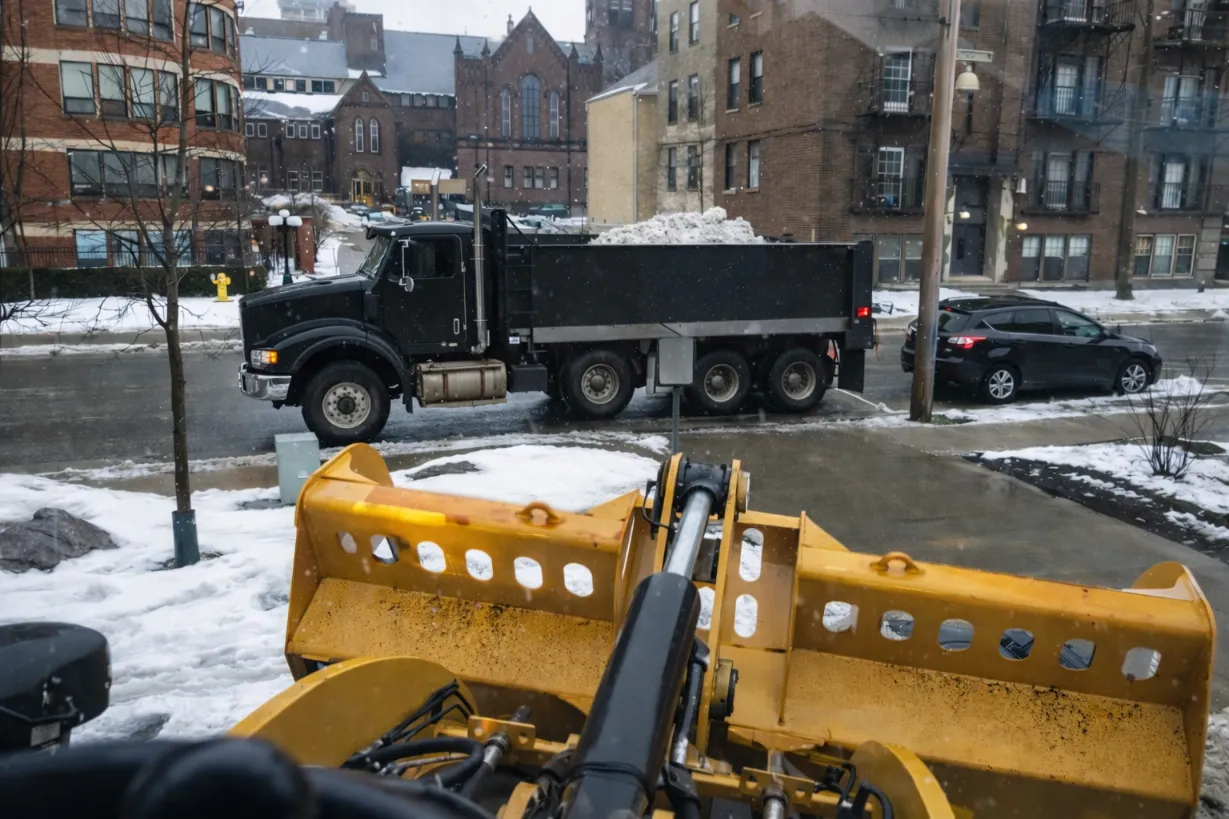
Snow piles grow all winter, and every foot they gain comes out of your parking. Once they start taking stalls or blocking the view at your exits, pushing them higher stops working.
That's when the wheel loaders load it out and DOT-compliant dump trucks haul it off the property. You get back the stalls and the sight lines, and the snow is gone instead of waiting for spring.
The trigger is the depth that sends crews out, and it drives the price of a contract more than anything else. Hopkins commercial accounts choose from four:
Tell us who uses the property and what time they get there, and we'll tell you which trigger we'd pick.
Every commercial property gets its own bid. The number depends on the lot's size, the trigger depth, the amount of sidewalk, and whether snow will need to be hauled off site.
Before the first storm, your property is mapped for push zones and drains, so every crew handles it the same way.
Yeti, our snow management platform, runs on every commercial site. Each visit is logged with arrival and departure times and site photos, along with every salt application.
When a slip-and-fall claim comes in, that log answers the questions that matter: what the conditions were, when crews were on site, and what was applied. Your business is named as additionally insured on a certificate of insurance before service begins, and you'll have direct cell numbers for the people running each storm instead of a call center.

Commercial work is our focus in Hopkins, but we take residential driveways too. Your driveway is cleared within 10 hours after snowfall stops on a 2 inch trigger, and our residential trucks all use rubber cutting edges to protect pavers and stamped concrete.
Homes follow the same 12-hour sidewalk and apron rule as businesses in Hopkins, counted from when the snow is deposited.
During a snowfall, Hopkins requires vehicles to be moved off city streets, city parking lots, rights-of-way and the Municipal Parking Ramp so crews can clear them. The city also points out that even a snowfall under two inches can make sidewalks hazardous, and its sidewalk rule sets no minimum depth. Snow removal details from the City of Hopkins and the Hopkins City Code.
Freshwater Landscaping
3425 Shoreline Dr Ste B, Wayzata, MN 55391
(612) 999-8067
Office: Mon-Sun 8am-6pm
City Code Section 36-175 gives them 12 hours. Snow and ice can't remain on a public sidewalk, carriage walk or driveway apron longer than 12 hours after it is deposited, and the rule is the same for homes and businesses.
Section 36-175 measures 12 hours from when the snow or ice is deposited, not from when snowfall stops. On an all-day storm, that is a tighter window than it sounds.
In the central business district, the city serves notice and gives 24 hours to clear it, half the 48 hours given elsewhere in the city. If it still isn't done, the city clears it at the owner's or occupant's expense, and unpaid charges become a special assessment on the property.
Yes. The lot follows the trigger depth in your contract, and the walks get shoveled and salted each time it snows. Hopkins sets no minimum depth for its sidewalk rule, so a light snow still counts.
Two inch, one inch, half inch and zero tolerance. Zero tolerance puts a crew on site before the snow starts to clear it as it falls, and two inch is the most common setting for a commercial lot.
Yes. Our focus in Hopkins is commercial, but residential driveways are cleared within 10 hours after snowfall stops on a 2 inch trigger. Every residential truck runs rubber cutting edges, and the front walk and steps are included.
Each commercial property gets its own bid, based on lot size, trigger depth, sidewalk footage and whether snow will be hauled away. Contracts come as a seasonal flat rate, per push, or a prepaid bundle of plow visits and salt applications.

After the thaw, the same crews look after your grounds through our commercial landscaping service.
No new vendor to vet in April, and no one learning your property from scratch.
Routes fill and then we're closed. Give us the property basics: lot size, how much sidewalk and apron frontage you have, what time people arrive, and whether you need zero tolerance. We'll put together a bid for your site.