CHANHASSEN, MINNESOTA
Your driveway is cleared within 10 hours after the snow stops falling. Not "as soon as possible." Not "we'll get to you." Ten hours from the last flake.
Chanhassen gives you twelve hours. Own a single-family home or a duplex here and the public sidewalk beside your property has to be cleared within 12 hours of the snow event. Not two days, not "when you get to it" — twelve hours, which for a storm that winds down at midnight means the clock runs out before lunch. And the city is equally direct about the other end of your property: it states that it does not clean driveways, and that its plows deposit a significant amount of snow in them.
Those plows work in stages. Local streets and cul-de-sacs get a single pass first just to open the routes, the target is every street open by 7:00 a.m., and the full curb-to-curb job can take up to 10 hours after the snow stops — which is why the ridge across your apron can show up twice from the same storm. Meanwhile ordinance section 12-16 keeps cars off the street from 1:00 a.m. to 7:00 a.m. between November 1 and April 1, and any time there is two inches or more down, until the street has been plowed curb to curb.
Most Chanhassen homeowners sign up for the season and stop thinking about it. Your property goes on the route before the first storm, service runs on a 2 inch trigger, and crews come when accumulation hits it — no phone call at 5am to ask whether we're coming. Seasonal flat rate or per push, whichever suits a winter that might bring four events or fourteen. Driveway, the walk to your front door and the steps are all part of it. Routes fill and then we're closed.
Homeowners across Chanhassen and the west suburbs have left us 80+ five-star Google reviews.
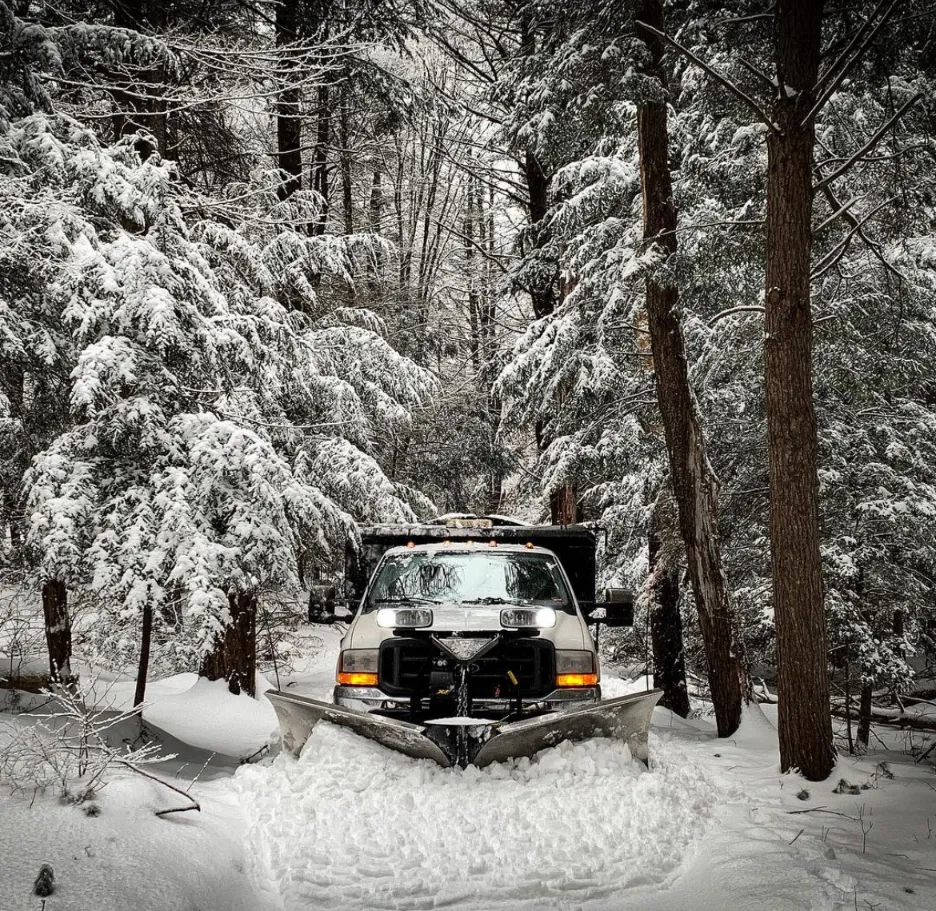
The city is not coming for your driveway. Chanhassen says outright that it does not clean driveways, and that its plows deposit a significant amount of snow in them. That is not a complaint about the city — a street plow has one job and it is the street — but it does settle the question of whose problem the berm at the bottom of your drive is. It is yours, twice over on a storm where the single opening pass gets followed by the full curb-to-curb run.
What we bring to it is rubber cutting edges on every residential truck. Steel does the damage people blame on Minnesota: a caught paver edge here, a scarred stamped concrete seam there, sealcoat scoured off in strips, all of it arriving as a spring surprise. Rubber rides over the same surface without taking anything with it. Drive edges get staked before freeze-up, so a crew on an unfamiliar wide apron out toward Bluff Creek at 4am is reading markers instead of guessing, and courts, brick and anything tight get hand or blower work.
The trigger is 2 inches. Reach it and your driveway is already scheduled for that storm, with nothing required from you.
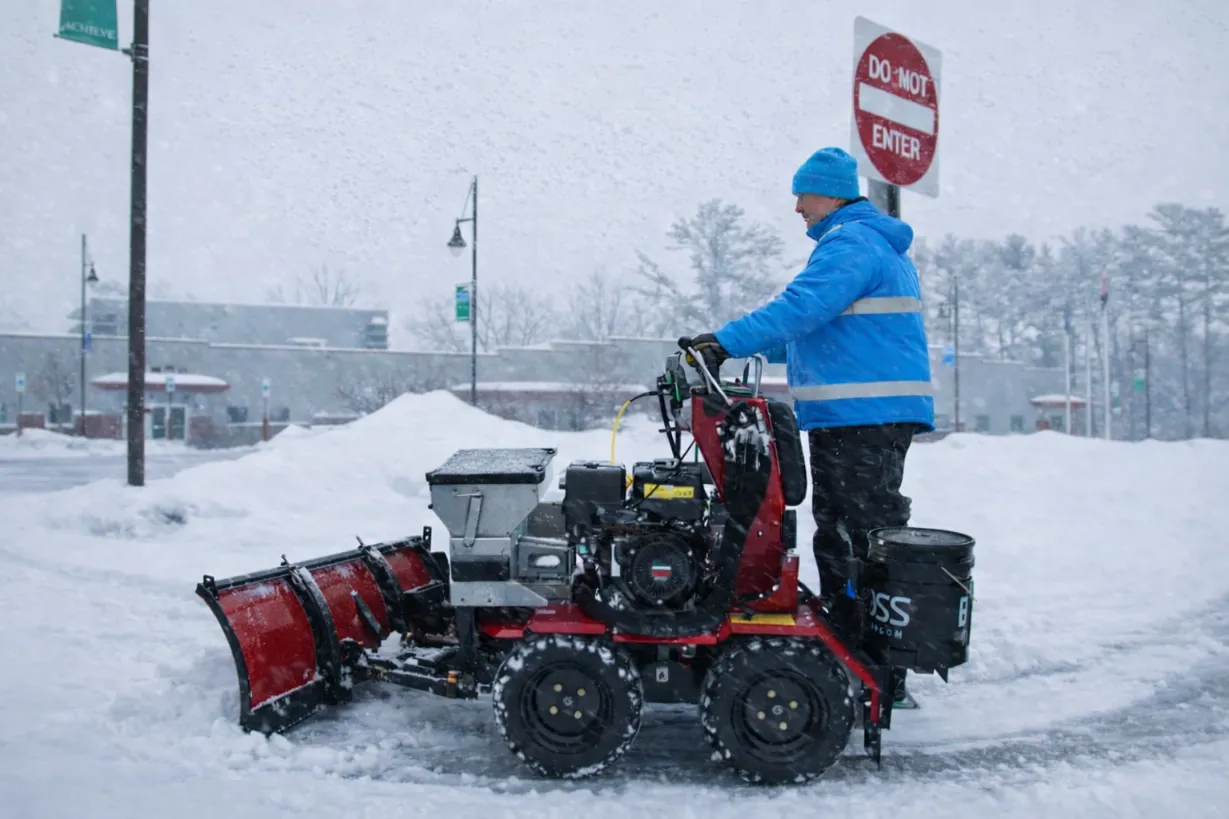
Chanhassen gives single-family and duplex owners 12 hours from the end of a snow event to clear the public sidewalk next to their property. Twelve. That is the tightest sidewalk window of any city we plow in, and it lands hardest on the storms that finish overnight, because the deadline arrives while most people are still at work the next day.
Walks and steps are included in residential service, done on the same stop as the driveway rather than as a separate errand. If your lot fronts public sidewalk, that footage can go on the same ticket, which is the simplest way to keep a 12 hour clock from becoming your problem at 6pm on a Tuesday.
The step work stays manual. Running a machine over stair treads and landings takes the edges off them a little at a time, so hand crews handle stairs, stoops and secondary entries — the same reasoning that keeps blowers off the brick and cut-stone entries around Lotus Lake and Walnut Grove, where replacing a damaged piece costs more than the time it would have saved.

The most dangerous surface of the winter is usually a driveway that looks finished. Sun works on dark pavement all afternoon, a thin skin of water spreads across it, and at dusk the temperature falls and that water turns into a sheet you cannot see from the back door. Every winter, more people go down on cleared pavement than on snow.
Our answer is to treat the surfaces underfoot and under tire — drive, walks, entry steps — on a schedule built around when refreeze actually happens rather than when it is convenient. And the salt is bought before the season, not during it: 100 tons sit at the shop from the start, so when supply tightens across the region after a major event, our routes keep running on inventory we already own.

Plowing is really just relocation, and every property has a ceiling on how much relocating it can absorb. You can watch a winter approach that ceiling: the bank at the end of the drive stops being a pile and becomes a wall, the view of oncoming traffic disappears behind it, and the usable driveway shrinks a foot at a time until two cars no longer pass. Cul-de-sac lots reach it soonest, since the pie-shaped frontage offers almost nowhere to push.
Past that point, adding to the pile only makes the next storm worse. So we take the volume off instead — shifted to open ground elsewhere on the property when there is somewhere to put it, and loaded into trucks and hauled away when there is not.
Most standard Chanhassen driveways run $200 to $250 per month, November through April. One seasonal price, billed monthly.
What moves the number: the length and width of the drive, how much walk and step work comes with it, and whether the property needs snow relocated once the banks fill.
Driveway length and width. Standard is up to two cars wide, about 20 feet, and up to 60 feet long — roughly 1,200 square feet. Wider than three cars, longer than 60 feet, or a courtyard or turnaround at the top moves it up. Every additional 1,000 square feet is roughly another pass. Approach drives over 150 feet get quoted on their own.
Walk footage and number of steps. Standard covers up to 50 linear feet of walk and up to four steps. A second entry such as a side or service door, a walk that wraps the house, or a full stair run is hand work and costs more per foot than open walk.
Whether snow can be stacked on site. No added cost when there is open ground at the end of the drive with room for a season's volume. It moves up when retaining walls, beds or plantings sit tight to the pavement, or when the drive dead ends at the garage with nowhere to push. Relocation or hauling is quoted separately and usually only comes up on tight sites in a heavy winter.
Seasonal or per push. Seasonal is one price split into monthly payments November through April, and seasonal clients are cleared first. Per push is available — call us and we will talk through whether it fits your property.
All of the above assumes a 2 inch trigger. A tighter trigger moves the number more than driveway size does, so a property that wants closer to bare pavement all winter gets priced on its own.
Under ordinance section 12-16, on-street parking is prohibited from November 1 through April 1 between 1:00 a.m. and 7:00 a.m., and any time two inches or more of snow is on a street until it has been plowed curb to curb. Local streets and cul-de-sacs get a single pass to open the routes first, with the goal of all streets open by 7:00 a.m. and full curb-to-curb service taking up to 10 hours after snowfall stops. Sidewalks are the owner's job: single-family and duplex owners must clear the adjacent public sidewalk within 12 hours of a snow event. The city also states that it does not clean driveways, and that its plows deposit a significant amount of snow in them. Winter parking and plowing details from the City of Chanhassen.
Freshwater Landscaping
3425 Shoreline Dr Ste B, Wayzata, MN 55391
(612) 999-8067
Office: Mon-Sun 8am-6pm
Ten hours after the snow stops falling, you are on open pavement. A capped route is what makes that a promise instead of an aspiration, because the crew is never carrying more properties than one shift can actually finish.
No, and Chanhassen says so plainly: the city does not clean driveways, and its plows deposit a significant amount of snow in them. Local streets and cul-de-sacs get a single pass first to open the routes, with full curb-to-curb work taking up to 10 hours after the snow stops, so that ridge can be replaced more than once. Removing it is part of what we do on your property, at no extra charge and without a phone call.
Twelve hours from the end of the snow event, if you own a single-family home or a duplex. That covers the public sidewalk next to your property, and 12 hours is a tight window when a storm ends overnight. We can carry that footage on your ticket so it gets cleared on the same visit as the drive.
Not the way a steel blade would. Our residential trucks are set up with rubber edges precisely because steel catches paver joints, stamped concrete relief cuts and sealed asphalt, and chips them a little more each pass. Drive edges are staked before the ground freezes so an overnight crew can see the boundary, and confined or fragile areas are cleared by hand or blower.
Both. Walks and steps ride along with the driveway in residential service and get finished during that same stop. Treads, landings and back entries are shoveled by hand so the edges survive, and a property with unusual walk length or step count is priced for the work it actually takes.
Not at all. What sends the crew out is accumulation reaching the trigger, so the visit happens on schedule with or without you there. If you can leave the driveway empty when snow is coming, do it, because a clear slab gets cleared properly and a slab with a car on it does not.
Possibly, though it hinges on whether the Chanhassen route has any room left in it. The 10-hour standard only survives if the route stays capped, so once it is full we stop adding properties until the following winter. Send us the address and you will get a direct yes or no.

Most of our snow clients did not start as snow clients. They hired us for a patio, a drainage fix, or weekly mowing, and kept us through the winter because the crew already knew the property.
It works the other way too. The crew that plows your drive in January is the same one that can edge the beds in May, keep the lawn on a weekly route through the summer, and take down the tree that has been leaning over the garage since the last storm. One company, one number, one crew that already knows where your sprinkler heads are and which side of the drive holds water.
That is also why the winter work is careful. We know what goes into setting a paver drive on a proper base, so we are not going to spend four months dragging steel across it.
Routes fill and then we're closed. Tell us about your property and what needs clearing, and we'll get you a spot. The storm-alert checkbox is optional — check it and you'll get a text the moment crews head out.